
 Digital Multiplex (DMX) allows bi-directional control and feedback from lighting fixtures and devices. It is a robust and reliable system for lighting control. However, without the proper cables and connectors, problems can arise such as random flashing of lights, erratic operation and delays in responding to commands. The following is a cable guide of our cables, connectors and terminators for proper and seamless connections with our lighting system. Contact us for ordering information.
Category: Guides
Guides
Understanding IP Ratings


What is an IP rating?
IP stands for “Ingress Protection“. It’s a two-digit code used to indicate the level of protection provided against solid objects (like dust) and liquids (like water). The first digit refers to protection against solid objects. The second digit refers to protection against liquids.
-
 ETL Wet Location: ETL wet-location ratings signify that electrical products (like lights) are tested by Intertek to withstand direct exposure to water, such as rain, snow, or splashes in showers.
 -
IP66 or higher: This is the recommended IP rating for outdoor lights. It means the light is completely protected against dust and can withstand strong jets of water from any direction. This is sufficient for most outdoor lighting needs, including heavy rain.
-
IP67: This rating indicates complete protection against dust and temporary immersion in water (up to 1 meter deep for 30 minutes). While it offers more protection than IP66, it’s typically more than necessary for most outdoor lighting situations unless you expect the lights to be submerged in water occasionally.
-
IP68: This is the highest level of protection against dust and water, meaning the light can withstand continuous submersion in water under specific conditions. This level of protection is usually more than necessary for standard outdoor lighting.
 ETL Wet Location: ETL wet-location ratings signify that electrical products (like lights) are tested by Intertek to withstand direct exposure to water, such as rain, snow, or splashes in showers.
 IP66 or higher: This is the recommended IP rating for outdoor lights. It means the light is completely protected against dust and can withstand strong jets of water from any direction. This is sufficient for most outdoor lighting needs, including heavy rain.
 IP67: This rating indicates complete protection against dust and temporary immersion in water (up to 1 meter deep for 30 minutes). While it offers more protection than IP66, it’s typically more than necessary for most outdoor lighting situations unless you expect the lights to be submerged in water occasionally.
 IP68: This is the highest level of protection against dust and water, meaning the light can withstand continuous submersion in water under specific conditions. This level of protection is usually more than necessary for standard outdoor lighting.
Certifications and Compliance

Product Memberships, Certifications and Compliance
At Insight Lighting, we’re committed to providing high-quality, reliable lighting solutions that meet stringent industry standards and customer expectations. Our products are designed with precision and care, and many hold certifications, demonstrate compliance with key regulations, or reflect our membership in programs that underscore our dedication to quality, sustainability, and ethical sourcing. Below, we’ve outlined some of the significant certifications and compliances that reflect our commitment to excellence.
- Buy American Act (BAA) Compliant: The Buy American Act is a federal law that restricts the purchase of supplies that are not domestic end products. For Insight Lighting, BAA compliance signifies that certain of our products are manufactured in the United States from domestically sourced materials. This compliance is particularly important for projects funded by the U.S. government, ensuring that taxpayer dollars support American manufacturing and jobs. When you see BAA compliance indicated, you can be assured that the product meets the stringent sourcing and manufacturing requirements of this act. For more information, please see official FAQ PDF page: Learn More
-
Build America, Buy America (BABA) Compliant: The Build America, Buy America provisions, part of the Infrastructure Investment and Jobs Act, establish domestic content procurement preference for infrastructure projects. BABA compliance is more extensive than BAA, covering all iron, steel, manufactured products, and construction materials. For Insight Lighting, BABA compliance means that specific products meet the heightened domestic sourcing and manufacturing requirements for federally funded infrastructure projects. This compliance demonstrates our commitment to supporting American manufacturing and infrastructure development. For more information, please see official .gov page: Learn More
 Buy American Act (BAA) Compliant: The Buy American Act is a federal law that restricts the purchase of supplies that are not domestic end products. For Insight Lighting, BAA compliance signifies that certain of our products are manufactured in the United States from domestically sourced materials. This compliance is particularly important for projects funded by the U.S. government, ensuring that taxpayer dollars support American manufacturing and jobs. When you see BAA compliance indicated, you can be assured that the product meets the stringent sourcing and manufacturing requirements of this act. For more information, please see official FAQ PDF page:
  Build America, Buy America (BABA) Compliant: The Build America, Buy America provisions, part of the Infrastructure Investment and Jobs Act, establish domestic content procurement preference for infrastructure projects. BABA compliance is more extensive than BAA, covering all iron, steel, manufactured products, and construction materials. For Insight Lighting, BABA compliance means that specific products meet the heightened domestic sourcing and manufacturing requirements for federally funded infrastructure projects. This compliance demonstrates our commitment to supporting American manufacturing and infrastructure development. For more information, please see official .gov page:
Turtle-Friendly Lighting
Turtle-Friendly Lighting
At Insight Lighting, we are proud to offer amber, Turtle-Friendly lighting options designed specifically for applications in coastal and ecologically sensitive areas.
We understand the critical importance of protecting sea turtles, particularly nesting females and vulnerable hatchlings, near waterways and beaches. By selecting our amber Turtle-Friendly options, your projects achieve stunning, effective illumination while demonstrating a genuine commitment to environmental stewardship.
 Our amber option addresses the critical factor and provides light sources that emit only long wavelengths (560 nanometers or greater). These amber wavelengths are significantly less disruptive to sea turtles, preventing the disorientation caused by shorter blue and green light.
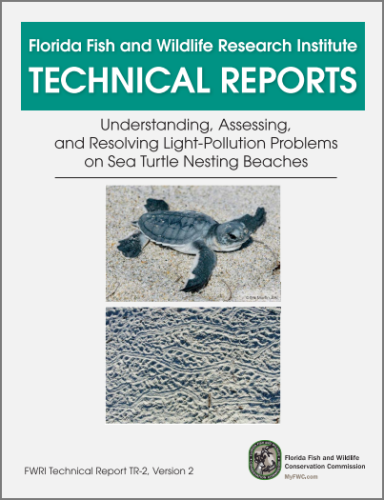
Our fixtures are engineered with features—including integrated louvers, directional mounts, and available shielding accessories—that provide the capability to comply with the principles and guidelines established by the Florida Fish and Wildlife Commission (FWC) and detailed in their Technical Report on Turtle-Friendly Lighting.
Understanding Turtle-Friendly Lighting
| Principle | Description | Why It Matters |
|---|---|---|
| Keep it Long (Wavelength) | Use light sources that produce only long wavelengths of light (560 nanometers or greater), which appear amber, orange, or red. | Sea turtles are less sensitive to true amber or red LEDs, as they do not produce the disruptive short, blue, and green wavelengths found in typical white light. |
| Keep it Shielded | Use fully shielded and downward-directed fixtures with opaque materials so the light source is not directly visible from the beach or water. | This directs light where it is needed for human safety (the ground) and prevents light trespass toward the ocean or sky, which can disorient turtles. |
| Keep it Low | Mount fixtures as low to the ground as possible and utilize the lowest necessary wattage or lumen output. | Minimizing the height and intensity of the light source reduces the overall visual impact on the coastal environment. |
Dimming Guide


0-10V Dimming
0-10V dimming has been used as an early fluorescent dimming system and still used today, 0-10V dimming has been adapted to become a reliable LED dimming control protocol and more commonly used within our industry.

DMX Dimming
A non-traditional though highly effective method for dimming and color tuning, DMX (Digital Multiplex) is a highly configurable protocol that offers control by individual sections or entire global systems. Consisting of 512 channels of data per stream, each stream in a system is referred to as its own Universe. The fixtures in each Universe receive channel data sent from a controller at a designated refresh rate.
PHASE DIMMING
Phase-cut dimmers work by taking the line input power (typically Mains Voltage) and modulating the signal to reduce the power to the load. By chopping the signal, the load experiences a lower voltage, resulting in a lower light output. The two most common phase-cut controls are forward phase and reverse phase controls.
 Forward Phase Dimming (TRIAC)
Forward phase-cut dimming (commonly referred to as incandescent or TRIAC dimming) is the most common dimming method. It is designed for resistive or magnetic low-voltage (MLV) loads, including incandescent and halogen, but certain models allow for more usage with LED loads. It usually uses a TRIAC dimmer that phase cuts the leading edge of the AC sine wave. Forward phase dimmers are often more affordable and simpler in terms of design than other types of dimmers.
 Reverse Phase Dimming
Reverse phase-cut dimming is very similar to Forward phase in which it phase cuts the AC sine wave but on the trailing edge of the it, allows it to dim according to the cut. ELV dimmers are generally very compatible with LED loads, offering smoother dimming to low levels. This dimming almost always requires the use of a neutral wire.
DMX Checklist
Download DMX/RDM Guide – PDF Format
Download DMX Wiring Technique White Paper – PDF Format
Troubleshooting your DMX set-up.
If a DMX problem arises, the solution is sometimes a simple overlooked item. Please look over the general checklist below before submitting a Field Service Support Request.
Are you using the proper Cabling/Wiring?
To ensure proper signal strength, 120-OHM shielded twisted-pair or Cat-5 to Cat-6 UTP cables are required.
Are you wiring to the DMX512 Standard?
Daisy-chain is the proper method of connecting DMX fixtures and controllers. With each fixture having an input and output, consider the signal as going straight-through from fixture-to- fixture. With the use of a DMX splitter, you can branch the daisy-chain, otherwise there will be electrical reflections and issues within the system.
Use DMX Splitters when needed.
If you need to go in multiple directions, use a quality DMX splitter. Without the use of a DMX splitter your signal will be weak to any branches on your topology. Remember to properly terminate your run.
Limit the number of devices on your DMX Loop.
The DMX standard for a single DMX Loop is 32 fixtures. The use of more than 5 fixtures will require a DMX splitter.
Limit the length of your wiring.
Our recommendation for wiring distance is an approximate length of 800 feet to the last fixture per run. The use of a DMX splitter will be required to increase the overall wiring distance.
Properly Terminate the last fixture on your DMX Loop.
Every DMX run should be properly terminated with a single 120-OHM (1-WATT) resistor. A DMX signal that reaches the end of the loop that isn’t terminated can bounce the signal back causing interference and result to flickering lights and loss of control.
Use a DMX Tester.
Use a DMX tester to analyze the signal at the far end of every DMX run. We recommend DMXcat for RDM addressing, monitoring, and testing.
Check your cables and connectors.
Check all DMX cables for cracks or breaks, including any solder joints. Also check connectors and terminators for cracks or a loose fit.
Check sources of electrical noise.
Keep unshielded cables clear from electrical motors or equipment that can create electrical noise or interrupt the DMX signal.
Is there a bad fixture?
Check your fixtures. It is possible for a damaged fixture to introduce noise or a bad signal into the DMX run. Try temporarily removing a fixture out of your DMX chain to see if problems disappear.
For existing customers that need additional troubleshooting support for their Insight Lighting products, please fill-out our Field Service Request form.
DMX/RDM Guide

 Download DMX/RDM Guide – PDF Format
Download DMX Wiring Technique White Paper – PDF Format
Remote Device Management (RDM) is an enhancement of DMX that allows bi-directional control and feedback from lighting fixtures and devices. Combined you get a robust and reliable system for lighting control. Contact us for ordering information.
Proper DMX Wiring Guide | White Paper
Congratulations on your decision to embark on the thrilling of wiring DMX, the universal language through which lights
converse, mingle, and occasionally throw dazzling parties. This guide will ensure your voyage of DMX wiring is as
smooth as possible.
BAA and BABA FAQ
 Download this BA and BABA Guide (PDF)
This guide provides a simplified overview of Buy America Act (BAA) and Build America, Buy America Act (BABA) requirements, along with answers to frequently asked questions. We aim to help you navigate these regulations and ensure your projects meet compliance standards.